The Flex-Down Math
Lowering your price can make you more money — but only under three conditions. Here's how to know which one you're in.
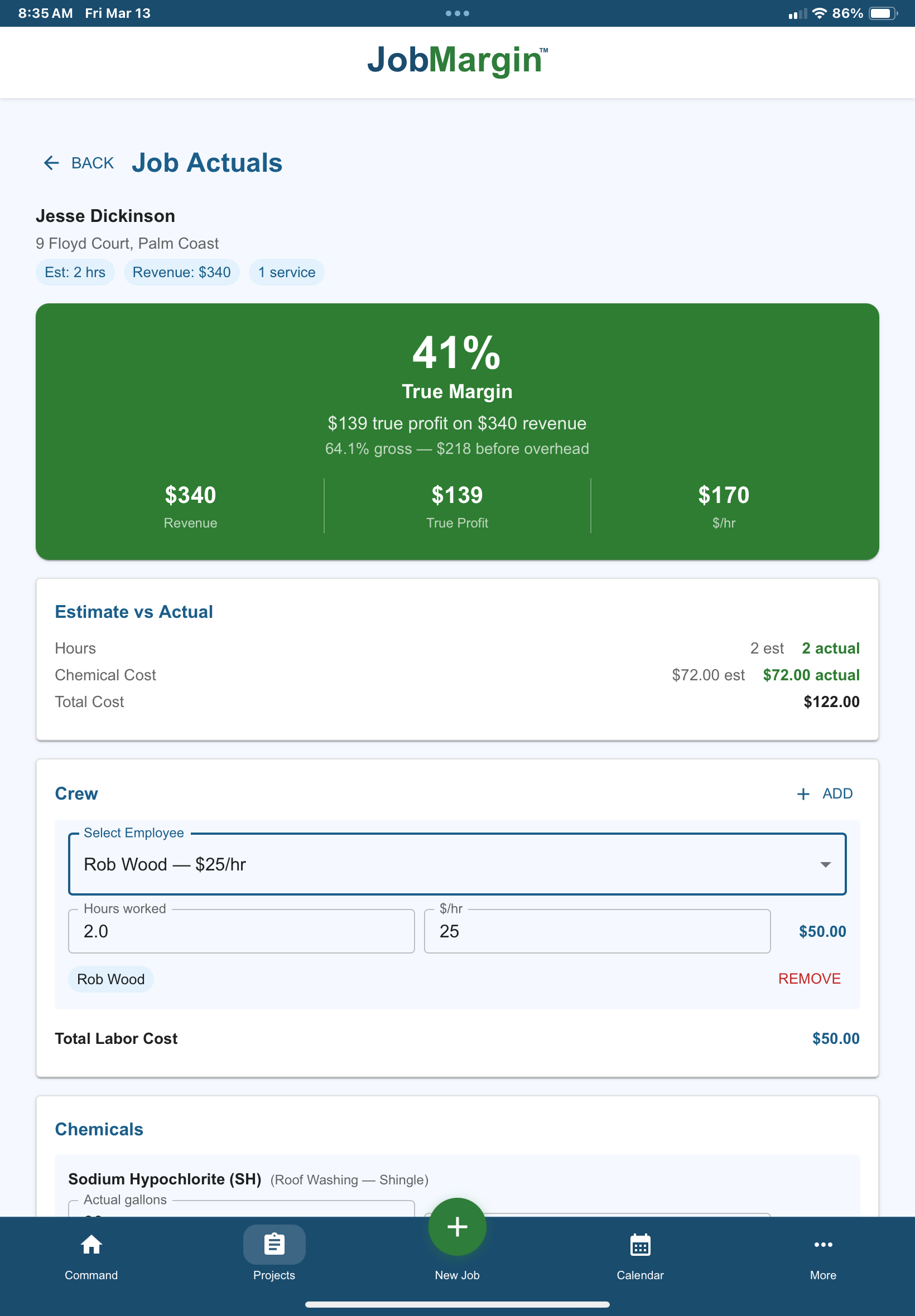
Lowering your price can make you more money — but only under three conditions. Here's how to know which one you're in.
Every contractor has been told to drop his prices at some point. Sometimes by a customer shopping him against a cheaper bid. Sometimes by a friend in the trade who claims he books more work at lower rates. Sometimes by his own head, late at night, looking at a thin pipeline and wondering if he's priced too high.
The advice usually sounds the same: "Just lower your price — you'll close more, and it evens out."
It doesn't always even out. In fact, it usually doesn't. Dropping a price without knowing what's structurally changing underneath can turn a profitable business into a busy one — more jobs, more revenue, less take-home.
But there are three specific situations where flexing a price down actually makes a contractor more money. Not in theory. Not in volume rhetoric. In real per-hour margin. When those situations exist, a lower price is the right move. When they don't, holding firm is.
Knowing which situation you're in is the whole thing.
Before the three situations, the baseline: every price change has to be evaluated against its effect on margin, not just on close rate.
A contractor who drops his price by 20% without any structural change in how he does the work is dropping his margin by close to 20%. Same labor, same materials, same drive time, same indirect cost allocation — just less revenue per job. That math doesn't recover on volume unless the volume increase is proportionally larger than the margin loss, and for most one-off residential work, it isn't.
So the first filter on any flex-down decision is simple: what's changing about the work that justifies the lower price?
If nothing is changing — same job, same customer type, same delivery — the flex-down is a margin giveaway. The contractor is subsidizing a price cut he didn't need to make, because he didn't first identify what the lower price was supposed to unlock.
If something is changing — bigger job size, repeat work, route density, operational simplification — the flex-down can actually work, because the cost structure is also moving.
Three situations where it does.
Commercial work runs on a different math than residential. The jobs are bigger, the properties are predictable, and the drive time disappears into a fraction of the day once you're on site.
I do flat work for Daytona State College at $0.10 per square foot. Soft wash at $0.12. My standard residential rate is $0.20 — so this is half my normal pricing. By the close-rate math most contractors would run, this should be a terrible deal.
It isn't. Here's why.
The per-hour margin on a commercial job at $0.10 per square foot is often higher than the per-hour margin on a residential job at $0.20 per square foot. The reason is structural. A commercial property gives me a single setup, a single breakdown, and hours of productive cleaning in between. A residential job at half the scale gives me the same setup and breakdown overhead and a fraction of the productive cleaning time.
Commercial work also benefits from repetition. The Daytona State work is known. I've done it enough times that the process is dialed in. There's no estimating time, no learning curve, no surprises. Every visit the crew knows where the water is, where the electrical is, where the sensitive areas are, and what the customer expects. Over two years, that one client has paid me $120,000 in revenue, and I'm running 50 to 55 percent true margin on that work when I do it myself.
The flex-down price at $0.10 is buying me volume on one property, repetition, and recurring revenue. Every one of those offsets the lower rate. I'm not making less margin on a commercial bid at half-price — I'm often making more margin than I would on a residential job at full price, because the cost structure is completely different.
The rule: If the flex-down unlocks commercial volume on a single predictable property, with repeat visits and efficient crew deployment, drop the price. The lower rate is paying for a higher-margin structure.
The second situation is the one most contractors underestimate, because it looks like giving up margin when it's actually building it.
A first-time house wash might be $300 at $0.20 per square foot for a 1,500 square foot property. When that customer signs up for quarterly maintenance, the per-visit price drops to $150. At a glance, the contractor just cut his price in half for the same customer.
Look at the year's math.
One-time customer: one wash at $300. Annual revenue: $300.
Quarterly customer: four washes at $150. Annual revenue: $600.
The quarterly price is half the one-time price, and the annual revenue is double. That's the first layer. But the real advantage shows up when route density kicks in.
Once I have five customers on the same subdivision running the same quarterly cadence, I'm not scheduling five separate jobs with five separate drives. I'm running them back-to-back in a single morning. Setup once. Park once. Pull hose from the truck once per house. Break down once. The per-job overhead — indirect cost allocation, setup time, drive time — collapses onto a single shared envelope.
Five quarterly washes on the same street runs me about $750 in a morning. Direct costs for that morning are modest. Indirect cost allocation is one morning's worth of truck time, not five separate allocations. The per-hour margin on that morning is higher than most standalone residential work I do.
The rule: If the flex-down unlocks recurring revenue AND route density, drop the price. The lower per-visit rate is paying for a higher aggregate margin on a tighter operational footprint.
Without both — if the recurring work is spread geographically across the service area, with no density — the math is weaker. Recurring revenue alone helps. Recurring revenue plus clustered routes is where the flex-down actually wins.
The third situation is the least obvious and the most rewarding when it applies: flexing down to take work that simplifies the operation, even when the margin per job is lower.
A contractor running three different trades for three different customer types is managing three different sales pipelines, three different pricing models, three different crew workflows, and three different material inventories. Every additional complexity multiplies the friction of running the business.
If flexing the price down on one trade consolidates the operation around a simpler mix — say, taking more recurring pressure washing work at a slight discount to reduce reliance on one-off paver jobs that require different equipment, different chemicals, and different scheduling — the per-job margin comparison is misleading. The real calculation is total take-home across the operational load, not margin per individual job.
This is the hardest one to run the numbers on, because the savings show up in time, friction, and mental load rather than in direct margin. But a contractor who can reduce his operational complexity by 30% is often making the same money with a fraction of the stress. That's a flex-down that pays.
The rule: If the flex-down simplifies the operation — fewer trades, fewer pricing models, fewer equipment setups, less context-switching — the lower per-job margin may be buying a higher business-level margin. Run the math on the full operation, not the individual job.
Here's the quick version for when a flex-down decision is in front of you:
Is the job commercial, bigger than a typical residential bid, with potential for recurring scheduling? Flex down. The structural advantages will pay for the lower rate.
Is the job recurring AND clustered with other recurring work on the same route? Flex down. Route density is where residential flex-down actually makes money.
Does the lower rate let you consolidate or simplify the operation? Flex down, but run the math on the full business, not the individual job.
None of the above? Hold firm. A flex-down without structural offset is just margin giveaway. The customer may still hire you at your regular rate — customers who shop aggressively on price were often going to be bad customers anyway. Customers who value the work will pay what it's worth.
Worth saying clearly: flex-down is not a response to slow pipeline, seasonal lulls, or general scarcity anxiety.
If the phone isn't ringing, dropping prices is the wrong reflex. The right reflex is marketing — more lead gen, more referrals, more follow-up on past customers. Contractors who respond to slow months by cutting prices end up training their market to expect lower rates permanently. The slow month passes. The lower prices don't.
Flex-down is also not a response to a single lost bid. The bid you lost to a cheaper competitor wasn't necessarily a pricing problem. It might have been a value communication problem. It might have been a customer who was only ever going to hire the cheapest guy. It might have been a legitimate mismatch where you weren't the right fit.
Dropping your price the next time because you lost a bid turns one lost job into a systematic margin cut. The next time around you win the bid, make less money, and wonder why the business feels harder to run.
Flex-down is a structural tool for structural situations. It's not a panic response.
When a contractor understands the flex-down framework, his pricing stops being reactive.
He stops dropping prices every time a customer pushes back. He starts asking himself — does this flex-down unlock commercial volume? Route density? Operational simplification? If yes, he drops. If no, he holds.
He stops losing money on discounted one-off work that felt good to book and ate his month. He starts building recurring revenue at rates that actually pay over the year.
He stops feeling desperate about every bid. The flex-down tool is there when he needs it, specifically and deliberately. The default isn't desperation pricing — it's measured pricing with a known floor.
That's the difference between a contractor whose price list is a wish list and a contractor whose price list is a calculated system. The flex-down is part of the system. It's not how you survive. It's how you grow, when the conditions are right.
Start a free trial. No credit card. Cancel anytime.