I'm Rob Wood. Last year I ran six paver sealing jobs at $0.90 a square foot. Broke even on every one. Here's the feature that would have told me not to take them.
Start Your Free Trial →14 days free · No credit card · Cancel anytime
Built for your trade
The real numbers
"Last year I got pulled into a paver sealing chain. A local installer was quoting homeowners $1.50 to $2.00 a square foot to seal their driveways. He wasn't doing the work himself — he was subbing it to a contractor who also wasn't doing it. By the time it got to me, the rate was $0.90 a square foot. Prep included. Sealer included."
"I ran the math in my head. It looked tight but doable. I ran six jobs at that rate with one employee. Broke even on every one. Then I stopped taking them and never looked back."
"Here's what I didn't know going in. A 2,000 square foot driveway sealed the right way needs roughly twenty gallons of sealer. At $295 a five-gallon bucket, that's $1,180 in material alone. My $0.90 rate on 2,000 square feet paid me $1,800. Subtract the sealer. Subtract the employee. Subtract the drive, the prep, the pressure wash, the fuel, the $59.63 an hour it costs just to run my business. Gone."
"If I'd had JobMargin on my phone when that first estimate came across, I never would have accepted the work. Per-material coverage rates on the estimate screen would have told me, in real time, what the sealer was going to cost before I clicked send. That's what this page is about."
The workflow
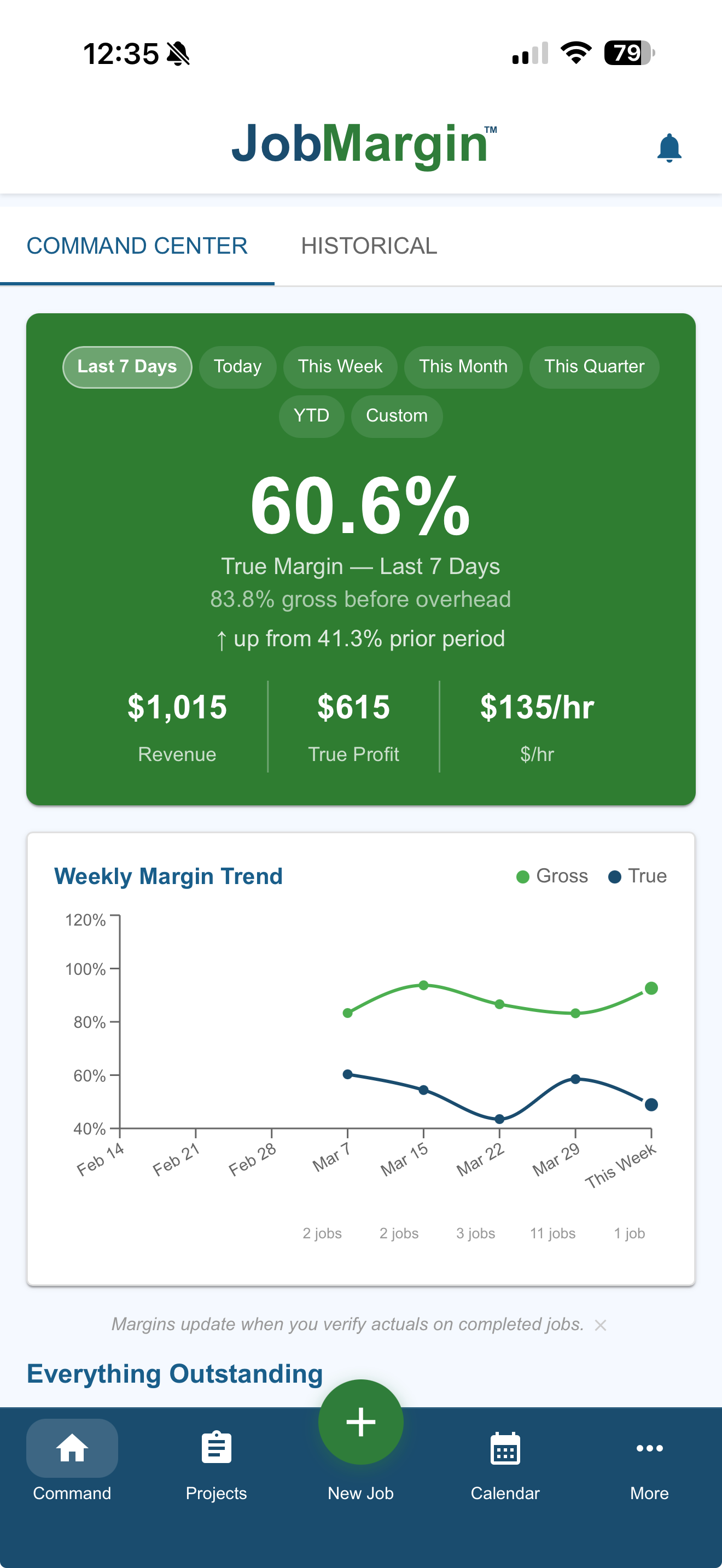
1. Command Center Review. First thing every morning, before I touch a lead or return a call, I open the Command Center. At the top of the screen: a running margin — today, this week, this month, last seven days. Below it: Google reviews I need to send, unpaid invoices that need a follow-up, jobs ready to invoice, estimates out that need a nudge, jobs where I still owe myself an actuals update so my real cost is on the record. I clear the board before I do anything else.
2. New Customer. Lead comes in from any channel — BNI referral, Google search, website form, email, phone. I call first. Name, email, phone, service address, what they're looking for — new seal, reseal, strip-and-reseal, commercial contract. That conversation isn't in the software. Everything downstream of it is.
3. New Job/Estimate. I enter the property measurements — driveway square footage, walkway, patio, pool deck. When I can, I pull the property off Google Street View and drop the photo into the estimate. Then I build the job. The sealer I'm planning to use comes from the Materials Library with its coverage rate already set — 100 sqft per gallon for wet-look acrylic, 175 sqft per gallon for penetrating sealer, whatever the product spec sheet says. The app calculates how much sealer the job needs. I don't guess.
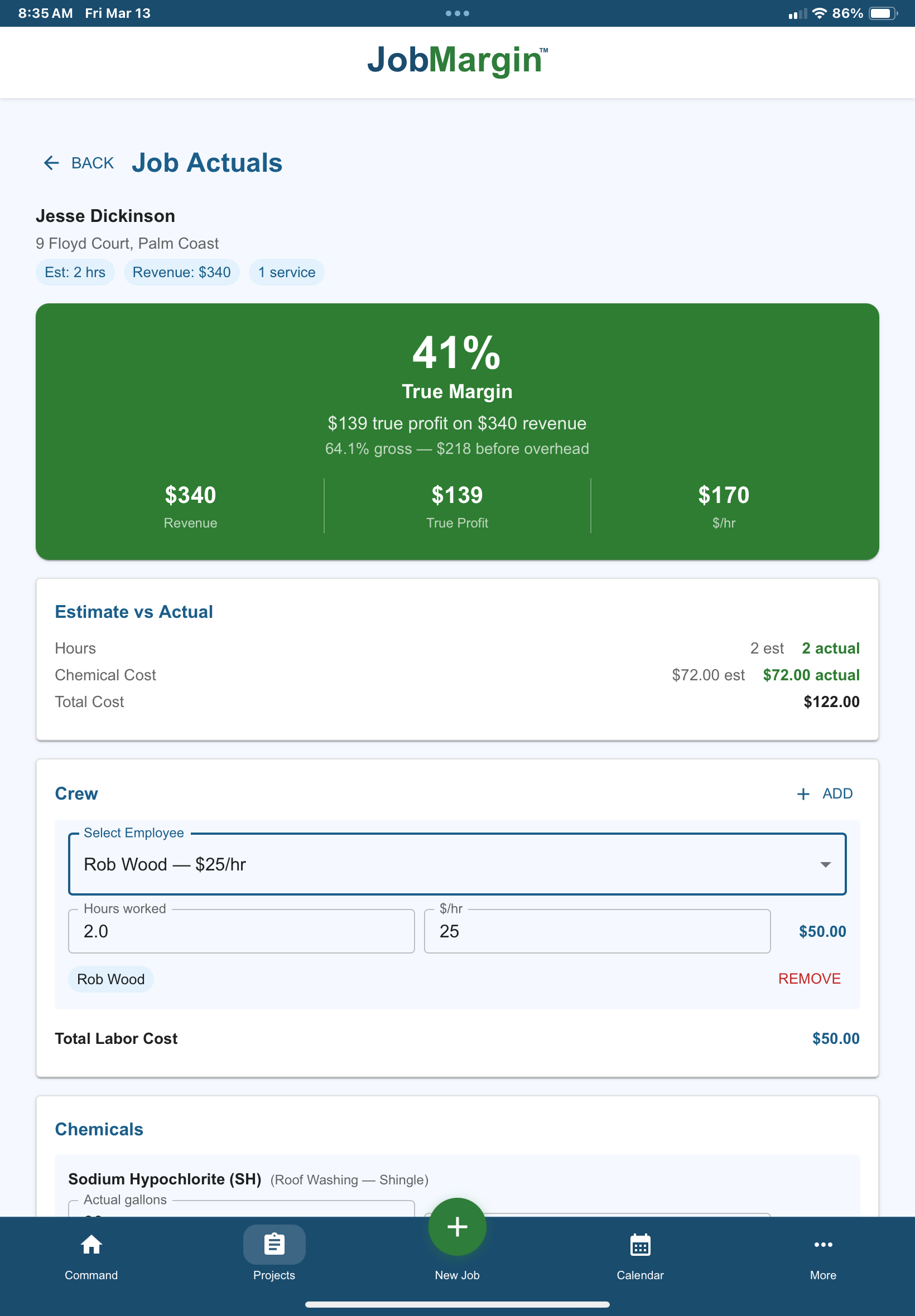
4. Verify Estimated Profit Margin. This is where the whole page you're reading comes from. The margin card on the estimate screen shows me what I keep — not gross revenue, not gross margin, true margin after sealer cost, prep labor, fuel, and the $59.63/hour it costs to run the business. If the number's right, I send. If it isn't, I don't. If someone wants me to seal 2,000 square feet for ninety cents a foot, the card tells me in red that this is a break-even job. Six times over last year, I ignored that instinct. I don't ignore it now.
5. Estimate Delivery and Acceptance. Professional and Enterprise customers get a permanent customer portal — they see the estimate, the photo of their property, the terms and conditions, and they accept it there. Starter customers get a direct estimate link for that single transaction. Either way, the app notifies me when they sign, and the job moves to Won on the dashboard.
6. Schedule Job. I put the job on the calendar and assign myself or a crew member. Paver sealing is weather-dependent work — if rain is in the forecast inside 24 hours post-application, the sealer doesn't cure right. JobMargin's auto-roll logic handles the reschedule cleanly, pushes it to the next open window, and notifies the customer.
7. Job Completion – Update Actual Costs. When the work's done, I update the actuals on the job — actual gallons of sealer used, actual labor hours, actual fuel. Now I have a real picture of what the job cost, not an estimate. If I budgeted 20 gallons and used 22, the margin updates. That's the data that makes next year's pricing sharper and tells me whether my coverage rate assumptions were right.
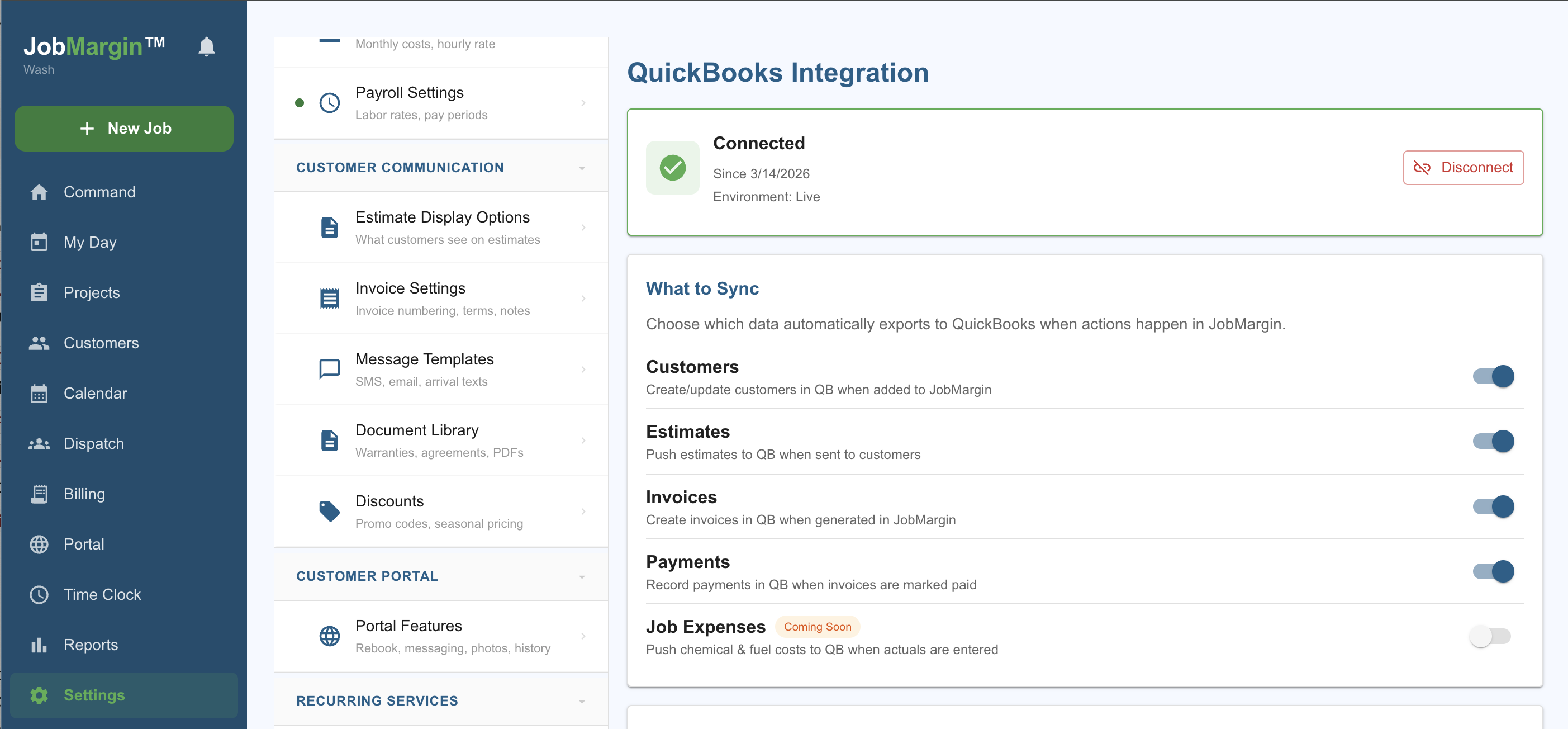
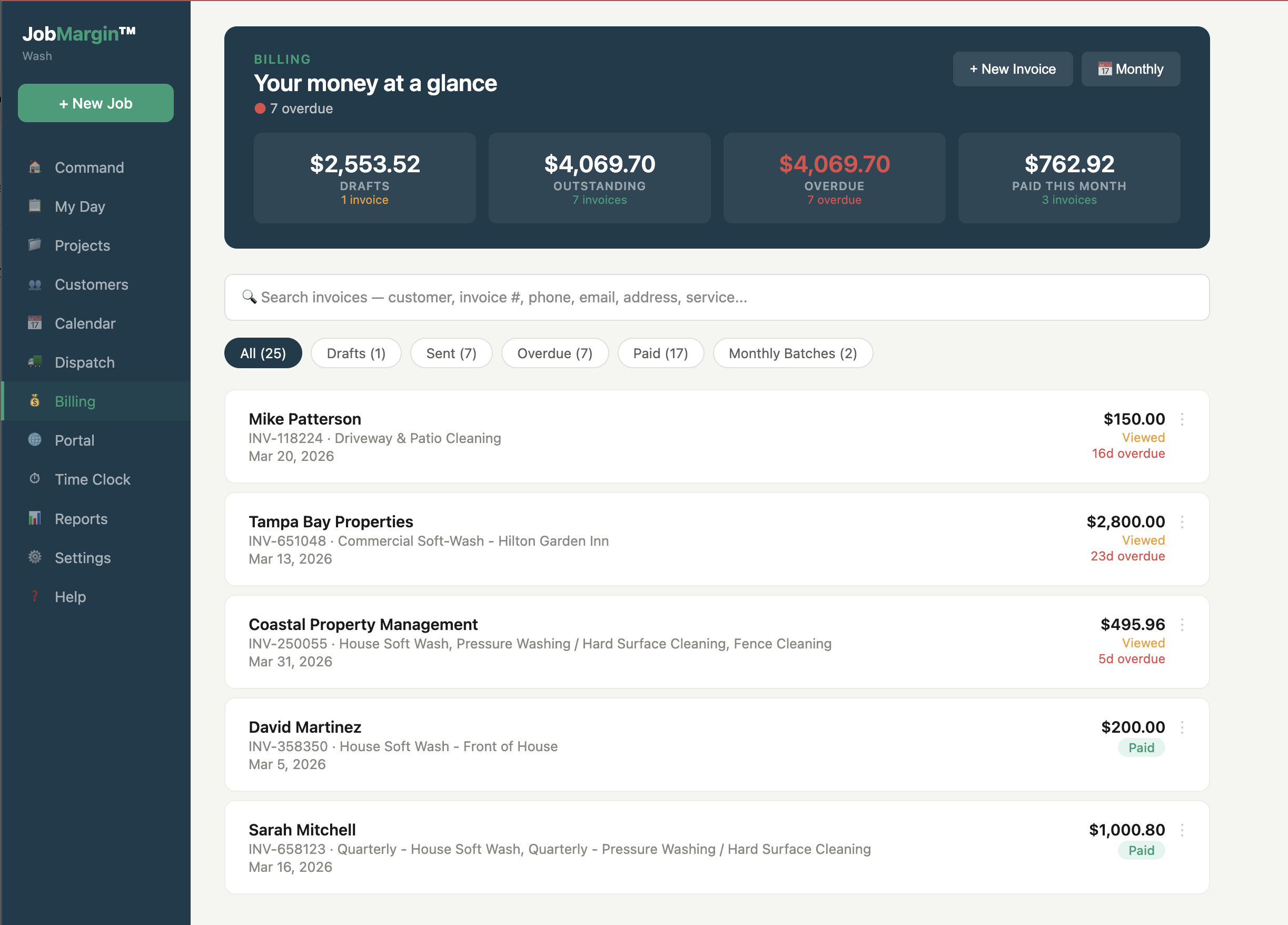
8. Send Invoice and Get Paid. Generate the invoice, send it, customer pays. Merchant services are integrated — convenience fee pass-through, so the customer covers processing and I net 100%. Estimate, invoice, payment all sync to QuickBooks automatically. My books are right without me touching them.
9. Reseal Cycle and Rebooking. Paver sealing is recurring work. Most jobs come back on a 2-to-5-year cycle depending on the product, the sun exposure, and whether the homeowner drove hot tires across the new seal before it cured. When I mark a job complete, JobMargin auto-creates the next reseal at the cadence I set — and it runs at a different rate than the first seal. First seal at my first-seal rate — heavier prep, thirstier pavers, more sealer. Reseal at my reseal rate. Two rates on the same customer record, whatever those rates are in your market. The customer portal lets the homeowner see the next reseal coming and request a different date without picking up the phone.
Know your number
Paver sealing is a material-heavy trade. A pressure washing job is maybe 5 percent material. A paver sealing job is 40 to 65 percent material. That changes how you price.
Most sealers don't track coverage rate accurately.
The sealer you buy has a coverage rate on the label — 100 sqft per gallon, 150 sqft per gallon, 200 sqft per gallon, depending on the product. Wet-look acrylics go further than solvent-based solid sealers. Penetrating sealers go further than film-forming ones. Porous or pitted pavers drink more than tight, tumbled ones. If you don't model coverage rate product-by-product inside your pricing tool, you're guessing. And on a trade where sealer is half your cost of goods, a 20 percent coverage-rate guess error is a 10 percent margin hit.
The other thing most paver sealers don't account for is the cost of leaving the driveway. Truck insurance, commercial liability, licensing, equipment depreciation, fuel, workers comp, software, credit card interest — all the things it takes to run a business that are indirect costs, meaning they're not tied to a single job. They come off the top every month whether you worked or not.
I ran my own numbers last year. It costs me $59.63 per hour of indirect cost to pay myself a living wage and cover all my insurances, loan payments, truck payments, and everything else. If my truck is leaving the driveway, it costs nearly $60 an hour just to operate, before I've squeezed a single trigger.
Armed with that number, and with real coverage rates on every sealer in my Materials Library, I price differently. I lose the jobs I should lose. I win jobs by being honest about what the work costs. I know exactly how far I can flex before a job becomes a break-even job. Six paver sealing jobs last year taught me that lesson the expensive way. JobMargin is the tool that teaches it to contractors the cheap way.
The feature that changes the math
Here's the thing that would have saved me the six break-even jobs.
Inside JobMargin, the Materials Library holds every product you use — every sealer, every joint sand, every prep chemical, every strip product. For each one, you set the coverage rate. Not at the job level. At the material level. Once.
Set them once. Every estimate you build from then on uses those coverage rates to calculate material cost in real time. Enter a 2,000 square foot driveway with wet-look acrylic, and the margin card shows you: 20 gallons at whatever you paid per bucket, total material cost, gross margin, true margin after your indirect cost. Live. Before you click send.
I've checked the competition on this. Jobber, Housecall Pro, Markate, QuoteIQ, GorillaDesk — none of them do per-material coverage rate math inside their estimate engines. They'll let you enter materials as line items with a unit cost, but none of them compute the material quantity from coverage rate and job square footage automatically. You either do that math in your head, on a calculator, or you guess.
I don't guess anymore. Neither should you.
Real rates
Most paver sealing sites won't publish rates. I will. These are honest residential rates in North Florida for work done right — clean prep, two coats where the product calls for it, joint sand re-stabilized, no shortcuts. They flex up or down based on condition, access, and what other work is on the truck.
Rates are a starting point, not a menu. The actual price comes from the margin card on the estimate screen — the one that tells me what I'll keep after sealer cost, labor, fuel, and the $59.63/hour it costs to run the business.
If you're quoting in a comparable market and your numbers look very different from these, that's not me telling you I'm right. It's me telling you that knowing your number is the difference between running a business and running a hobby.
The real cost
Paver sealing has a specific kind of trap you don't see as much in other trades.
A paver installer finishes a job. The homeowner asks about sealing. The installer says yes, we can seal it, we'll quote you — but the installer doesn't actually do seal work. So the installer quotes high ($1.50 to $2.00 per square foot) and subs the work to somebody who does. That sub might also be a middleman who doesn't actually do the work. By the time the job gets to the contractor holding the sprayer, the rate is $0.90 a square foot and the prep and the sealer are included.
That contractor breaks even. Six times, in my case, before I figured out what was happening.
I don't blame the installer for quoting $1.50 a foot. That's what a good seal job is worth. I don't blame the middleman for taking his cut. That's how chains work. I blame myself for accepting a sub rate without running the math on the sealer cost and the labor cost and the indirect cost before I said yes. I had no tool that would have shown me the true margin in real time. I had estimated material cost in my head and I was wrong by about 40 percent.
If you're a paver sealing contractor being fed sub work by an installer, a landscaper, or a concrete guy, run the numbers before you say yes. A two-thousand-square-foot driveway at $0.90 pays you $1,800. If the sealer alone is $1,180, you've got $620 left to cover one or two employees for half a day, fuel, drive time, equipment wear, and the business itself. You will not make money on that job.
JobMargin shows you the number before you commit. That's the whole point.
Scale ready
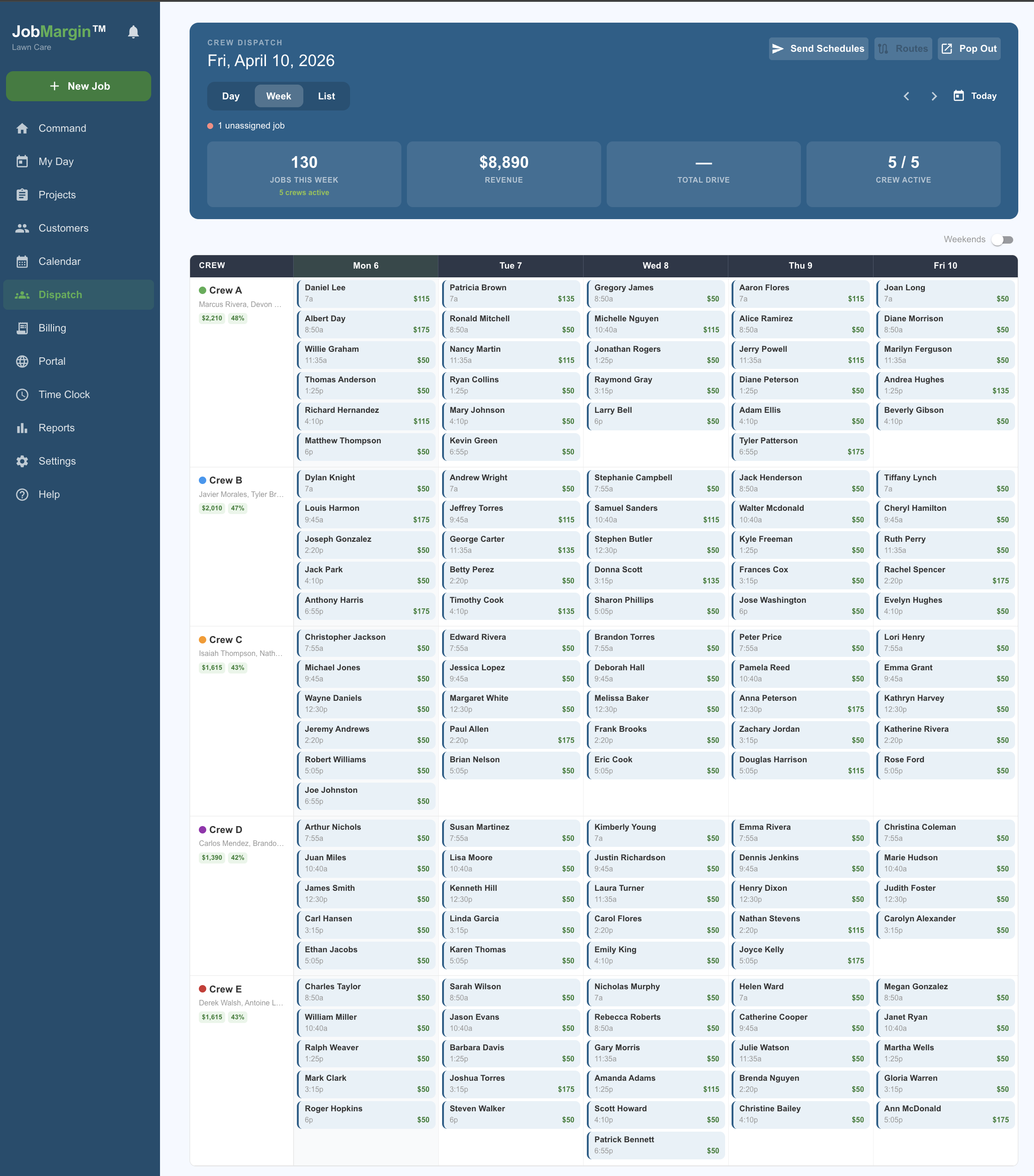
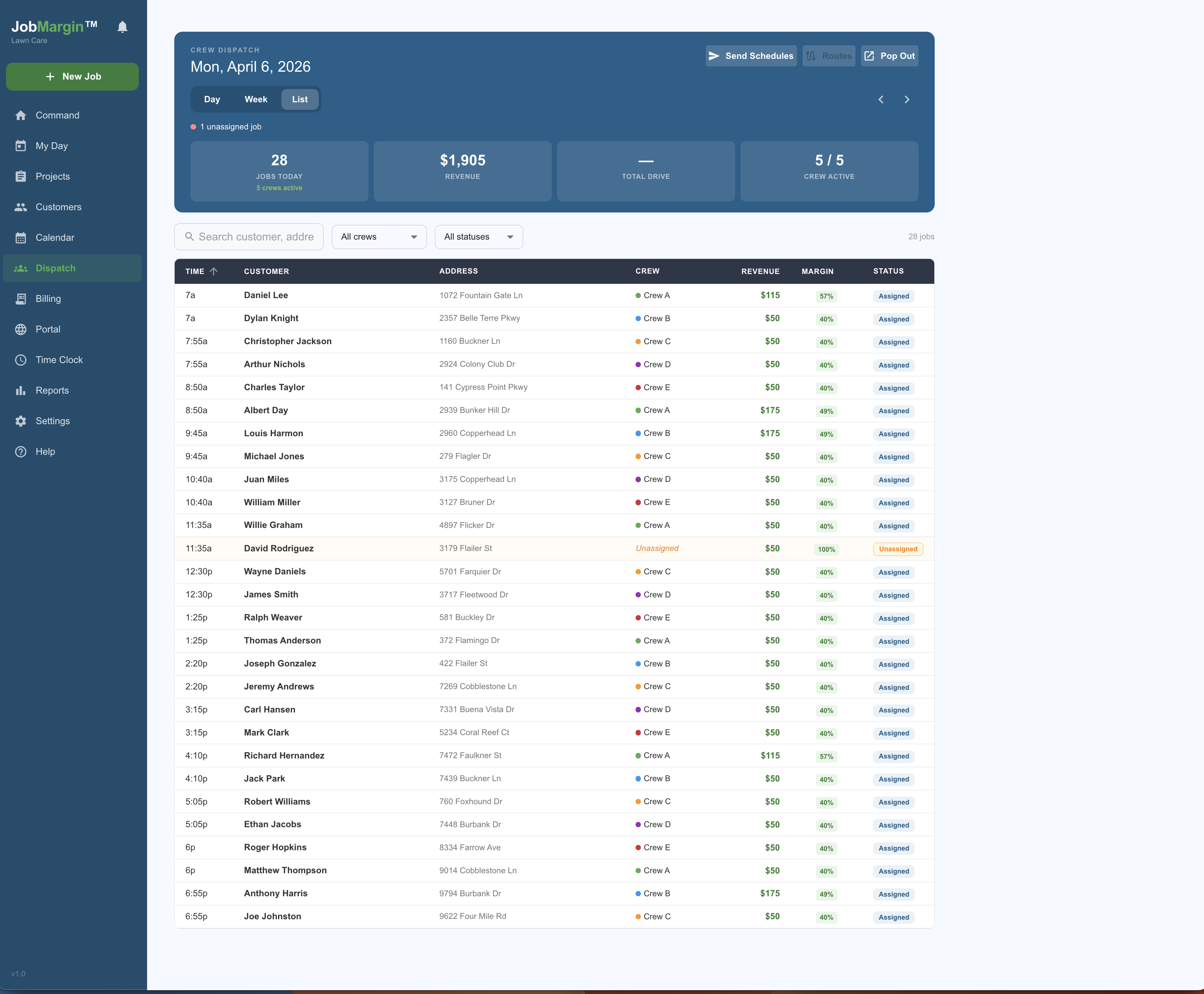
Most paver sealing contractors start solo. One truck, one sprayer, residential driveways. Then the reseal cycle catches up with them — eighty customers sealed three years ago all coming up for reseal in the same season — and the business either scales or it drops customers. JobMargin handles both ends of that growth.
Here's what scaling looks like on this tool:
Day Planning View
Week View
Day List ViewEfficiency
Paver sealing efficiency comes from three places: the right sprayer for the product you're using, buying sealer in quantity, and route density.
A battery backpack sprayer is fine for a single residential driveway. It's the wrong tool for an eighty-customer reseal route running all spring. When you hit that kind of volume, a gas-powered commercial sprayer with a dedicated tank cuts application time in half and gives you a more even coat. The upgrade pays for itself inside a season if the jobs are there.
Sealer is the same math. A five-gallon bucket costs what it costs. A fifty-five gallon drum costs less per gallon. A pallet costs less still. If you know your coverage rate per sealer and your job volume for the season, you know when the pallet price beats the bucket price. JobMargin's Materials Library gives you the per-gallon cost baseline. Your purchase ledger tells you whether you're buying at the right scale. The two together make the decision obvious.
Route density is the third lever. I batch paver sealing jobs into the same week in the same neighborhood whenever I can. One mobilization, multiple driveways, lower drive time per job, better crew utilization. The JobMargin calendar and dispatch views make that easy to see. If my truck is rolling, I want to be making real margin that day. The software keeps the schedule honest on that target.
What you get
The margin card sits on the estimate screen as you build it. Enter your services, your sealer, your expected labor hours. The card updates live. You see revenue, gross margin, and true margin after your indirect costs are allocated. Before you click send.

Starter, Pro, or Enterprise — QuickBooks Online sync comes included. Most of the category gates this to the second or third pricing tier. I don't. If you're running a business you need to be running books properly from day one.

The full flow. PDF generation, e-signature, deposits, partial payments, two-rate recurring billing for reseal customers. Convenience fee pass-through is built in so you net 100%.

First seal at one rate. Reseal at another. JobMargin tracks each recurring service separately, writes the next reseal automatically at your chosen cadence, handles weekend collisions, and invoices however your customer wants to be billed.

Day view, week view, list view. Move crews between jobs. Handle the callout when someone's sick. Print the day's schedule for a crew leader who prefers paper. Built because I needed it.

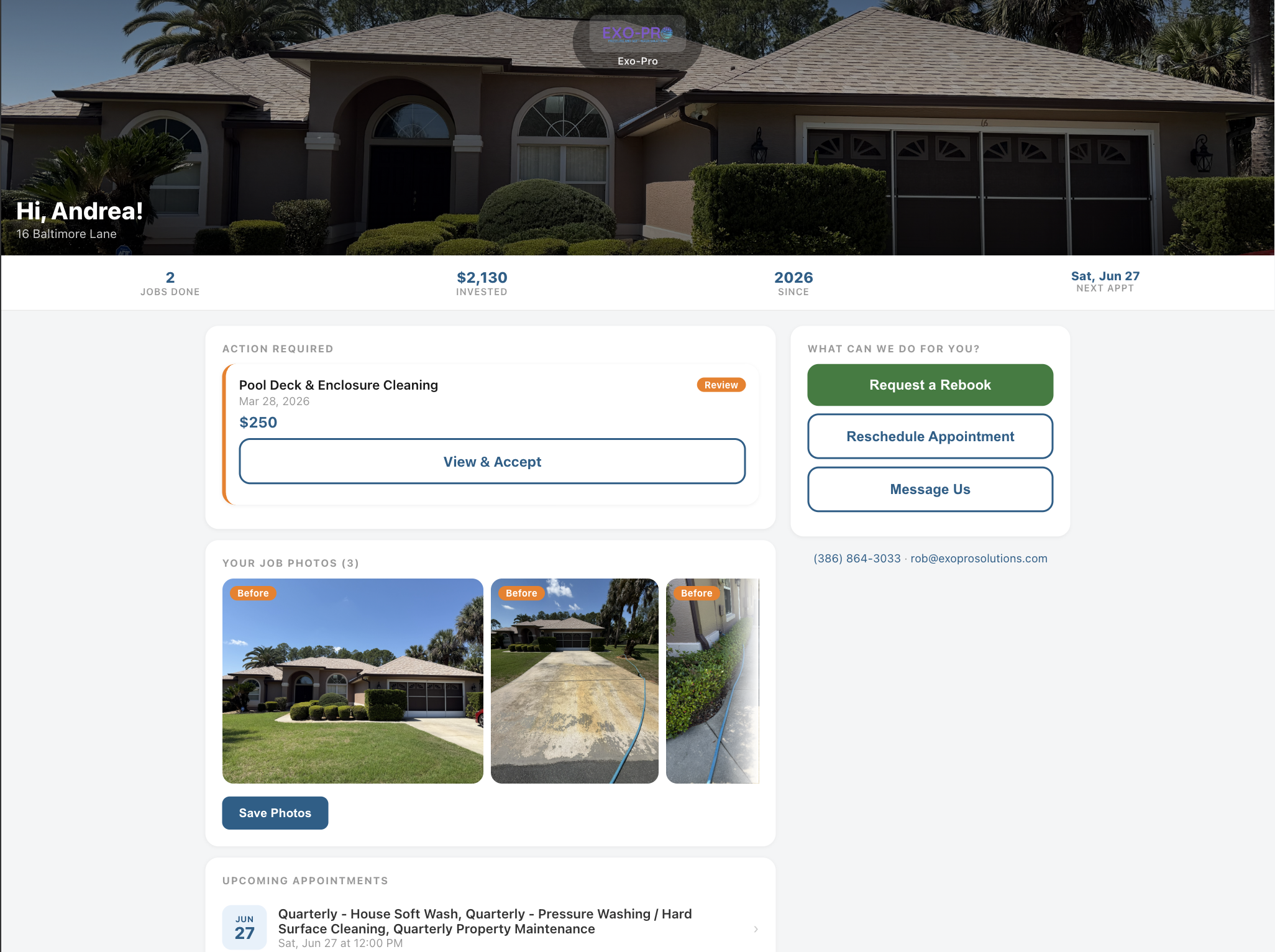
Every customer gets a permanent link. They see completed work, the upcoming reseal on the calendar, before-and-after photos, and they can request a reschedule from the portal with a preferred day and time. Fewer phone calls. Better retention.
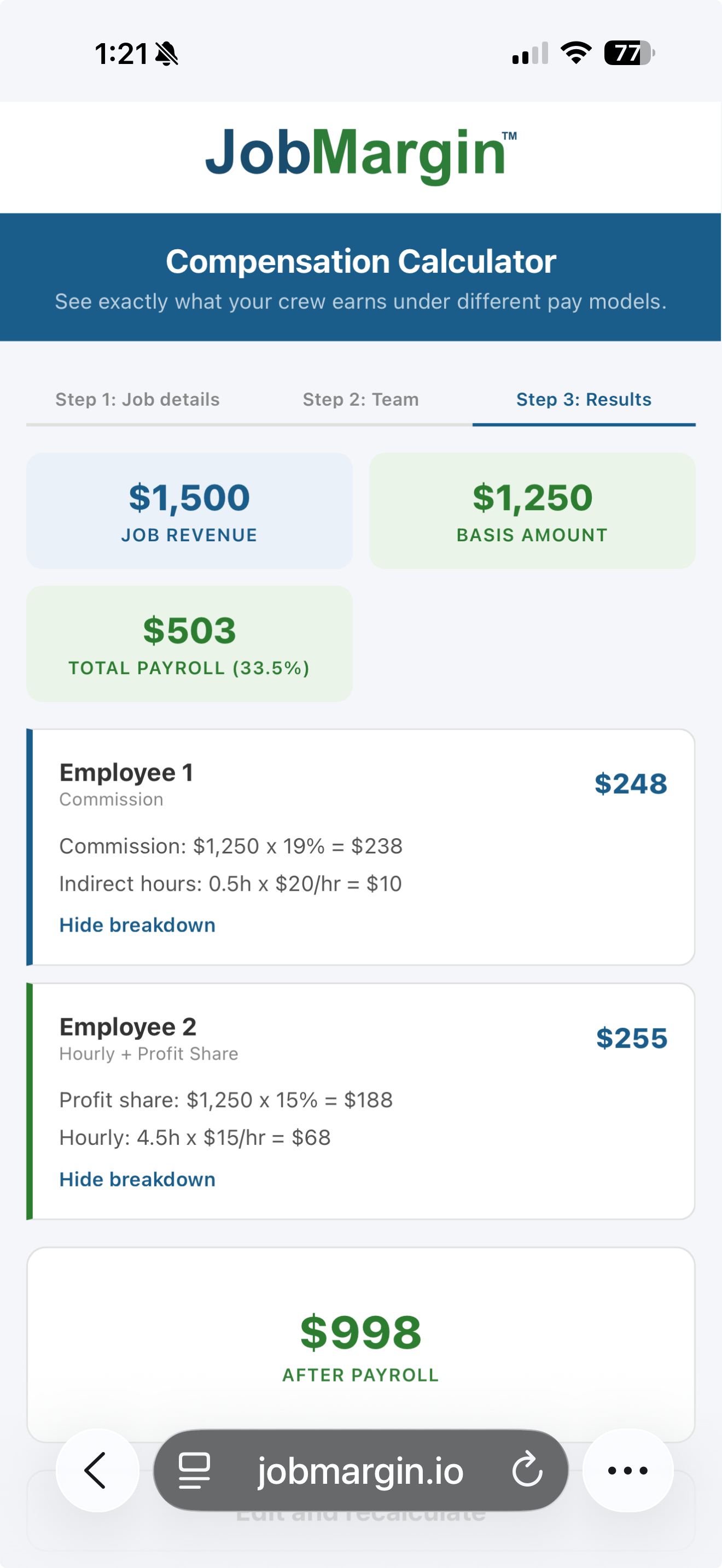
Run one paver sealing job through the compensation calculator. See what JobMargin would tell you about its margin.
Try the Calculator →
Simple pricing
Every plan includes a 14-day free trial with full access to all features.
Starter
One user. QuickBooks sync included. True margin on every estimate. Materials Library with coverage rates, scheduling, customer management, payment engine. 30 jobs per month.
Professional
Five users. Everything in Starter plus crew management, customer portal with reschedule, monthly invoice builder, employee app access. Unlimited jobs.
Available add-ons
Crew Dispatch +$49/mo
Extra users +$10/user/mo
Extra SMS +$19/mo
Enterprise
Unlimited users. Everything in Pro plus full crew dispatch, crew margin reporting, campaigns and offers, priority support.
No annual contracts. No credit card required for the free trial. Cancel anytime from inside the app.
Built by a contractor
I'm not a software developer. I'm a pressure washing and paver sealing contractor with a finance MBA, eleven years training crew chiefs in the Air Force, ten years managing faculty at a university, and a BNI chapter to run. I built JobMargin because I kept losing money on jobs that looked profitable on paper and I got tired of finding out weeks later why.
If that's you, give it a try. The free trial is fourteen days. You don't need a credit card. You'll see your real numbers on a real estimate within the first session.
Rob Wood
Founder, JobMargin · Owner, Exo-Pro Pressure and Soft Wash
FAQ
Yes. Customer import is built in. Existing work orders can be added manually or via QuickBooks sync if you're already using QuickBooks. Dedicated migration help is included for Pro and Enterprise accounts.
Yes. The app is responsive and works on iOS and Android browsers. Most paver sealing contractors walk the driveway, measure it, enter the services, and see the live margin card right there on site before the homeowner has finished pouring coffee. The interface is designed for that.
Gross margin is revenue minus direct costs — sealer, prep materials, labor, fuel on that job. True margin adds an allocation of indirect costs — insurance, truck payments, software, licensing, everything that takes money off the top every month. True margin tells you what you're actually keeping. On a paver sealing job where sealer alone can be 40 to 65 percent of revenue, the difference between those two numbers is the whole game.
Yes. The Materials Library lets you set coverage rate per item — wet-look acrylic at 100 sqft per gallon, penetrating sealer at 175 sqft per gallon, whatever the product spec sheet says. Set it once. Every estimate uses your real coverage math. You never under-buy and run short. You never over-buy and eat it.
Two rates, one customer record. The first work order runs at your initial-seal rate — heavier prep, more sealer, higher price. When you convert to recurring, the reseal rate is separate. Pick the cadence — annual, biennial, every three years, every five years — and JobMargin auto-generates the next visit on that schedule. The customer portal lets them see what's coming and request a reschedule without calling you.
Yes. Most field service software gates QuickBooks Online integration to their second or third pricing tier at around $99 to $149/month. JobMargin includes QuickBooks sync starting at $59/month. If you're running a legitimate paver sealing business, your books need to be right from the beginning.
Yes. The platform handles everything from a single residential driveway to a multi-day HOA or commercial plaza project in the same tool. Dispatch, crew management, recurring commercial contracts, and commercial-scale invoicing are all built in.
No. The fourteen-day free trial requires no credit card. You can import a customer list, set up your sealer products with coverage rates, build an estimate, and see your real margin number before you commit to anything.
If you're a paver sealing contractor who wants to see true margin on every estimate before you send it — including what the sealer will actually cost — start the free trial. Fourteen days. No credit card.